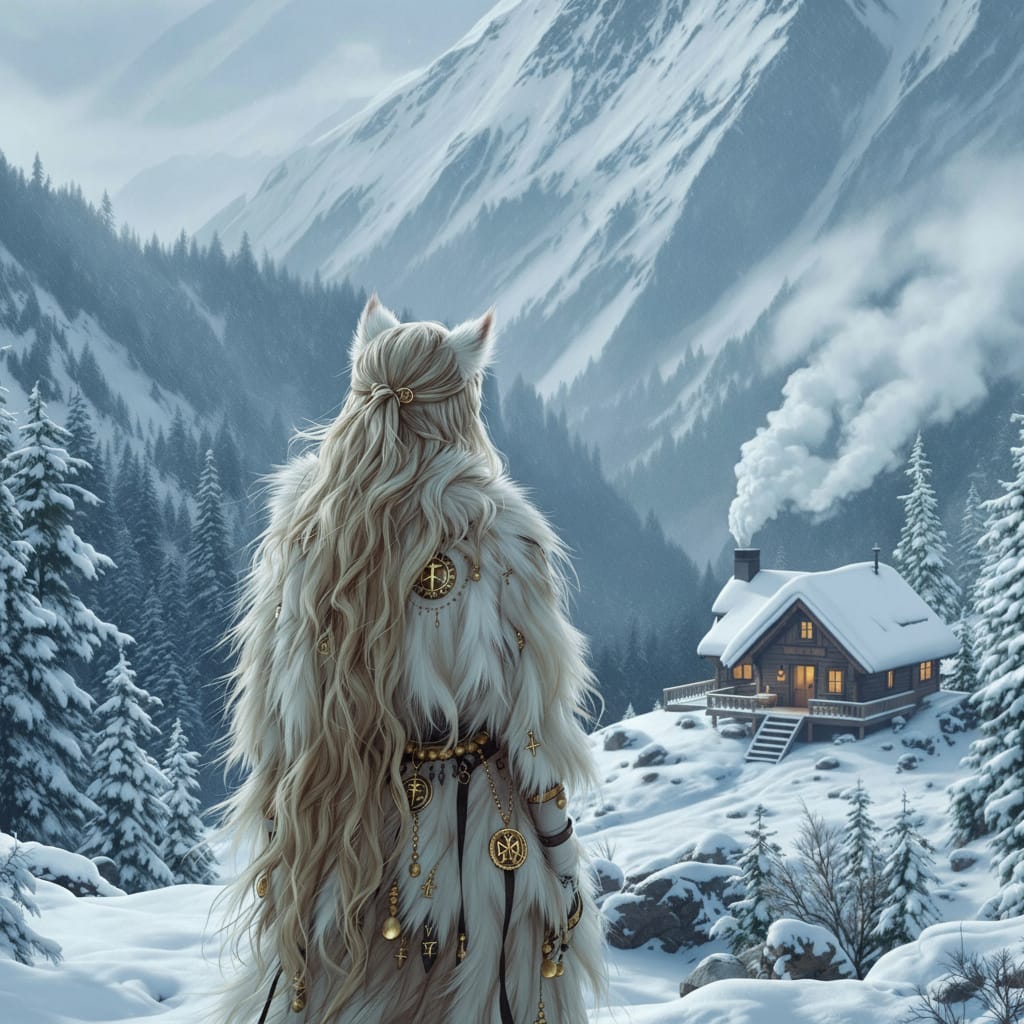
At the Hearth
“Snow does not hide the seed – it guards its moment to awaken.” – Onyx Iskra
Winter came not with silence, but with its own fierce song. Its voice wound through the trees like an ancient breath, neither cruel nor kind, only remembering.
In the heart of Moosewood, the wind carried whispers, and the dark held its own kind of listening. The forest breathed in rhythms older than memory—the crack of pine, the groan of ice, a hum that might have been wind—or prayer.
Snow sifted through the tall branches like soft ash, settling on the antlers of sleeping trees, and the river moaned somewhere beyond, its ice splitting in slow, echoing cracks.
But deep where the wind’s song faded, cradled by the roots of the ancient grove, a hearth glowed—older than the village itself, older even than memory.
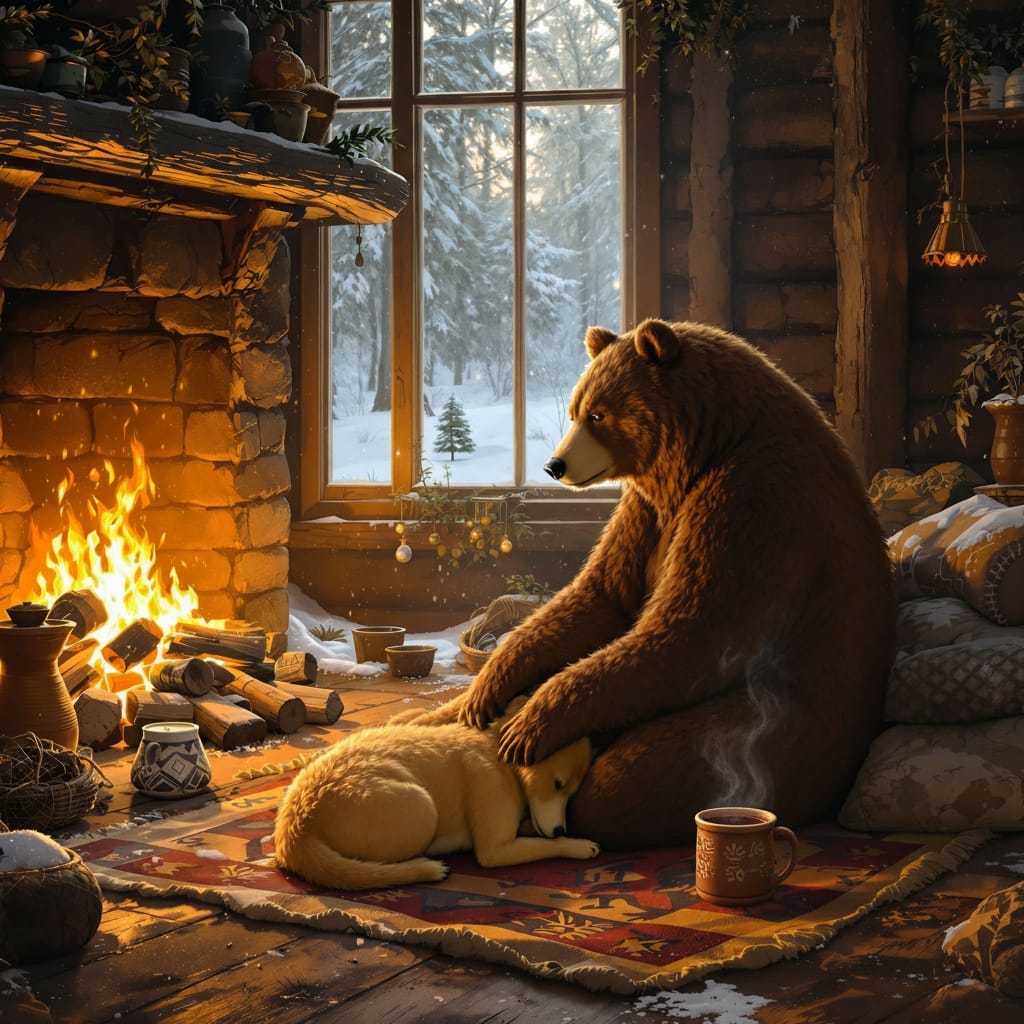
The hearth fire crackled low, embers sighing in the quiet cabin, the faintest trace of cedar hidden beneath the smoke. Before the sun found the courage to rise, Auriel stirred first, nosing at the cooling coals. Bear followed, her paws thick with soot, her fur lined with frost. She moved with ritual precision—sweeping ashes, stacking kindling, coaxing flame. This was her devotion—the tending of Moosewood’s heart.
Bear settled cross-legged on the worn rug. Auriel, the golden hound, curled at her side, soft fur warm against her knee. Auriel’s pelt caught the firelight like sunlight caught in honey; her eyes mirrored every flicker of Bear’s heart. When Bear sat heavy at the hearth, Auriel pressed against her side, heartbeat to heartbeat.
In Auriel’s steady gaze flickered the same quiet vigilance that burned in the hearth—neither master nor servant, but a keeper of what endured. She needed little: only warmth, company, and the quiet joy of being near.
Bear traced the rim of an old wooden mug, tea cooling as she pondered. Her gaze flicked between the flames and the dance of light beyond the icy window—the northern ribbons she’d grown up watching yet never quite understood. In the tea’s steam she caught the faint ghost of mint and spruce, sharp and green, like breath drawn from the forest floor.
Auriel sighed, resting her muzzle on Bear’s lap, eyes half-lidded. A soft reminder settled: breathe. Bear managed a small smile, hand moving to scratch behind her ears.
Stag rustled from across the room. His tread was slower now, careful on the creaking floorboards as he lumbered outside to the wood stack. He would soon reappear with a bundle, quiet as ever, offering no words but presence. That was his way—solid, understated. His quiet anchored her, even when she wished for something louder she couldn’t name. Even silence was its own kind of language between them—one forged through years of shared winters, of words that burned too quickly when spoken.
Deer had been gone for months now. He moved past the ridges, chasing steadiness in a world beyond Moosewood. His letters came now and then, tidy and neat, steady as his hand. He was stable. Predictable. Everything Lynx once wanted—and now despised.
Bear’s chest tightened at the thought of Lynx, a flicker of unease crossing her features. Lynx had always been wild and beautiful—untameable. When she was younger, Bear admired it; as she grew older, she feared it.
Bear’s eyes drifted back to the auroras, a pull in her chest she’d never spoken aloud. She used to dream of following those lights north, to see what waited at the edge of the world. But life had been louder—filled with work, the hearth, responsibilities. That part of her—the restless part—had been buried under lists and obligations. Still, some nights, it stirred. She called it wanderlust. But now she was simply tired—of the hearth, of the waiting, though she’d never say so aloud.
The hush pressed close, and she felt the weight of her own heartbeat—slow, steady, unwilling to quicken. Even rest had begun to feel like labor.
A soft rustle broke her reverie. From the shadows, Onyx padded into the room, black fur glinting like midnight silk; the air wavered, warm then still. He blinked slowly, tail curling around his paws, and regarded Bear with those embered eyes.
“Not all stirrings are meant to wander.”
The whisper brushed her mind, delicate as wind through pine needles.
“Some wait, patient, to be noticed again.”
Bear stilled, breath caught in her throat. The words rooted in her chest, faint but insistent, like embers refusing to die. Something within her turned toward them, not in understanding, but recognition.
She glanced toward the sound of Stag’s thumping footsteps as he clambered up the outdoor steps, then back to the cat—but Onyx had already melted into the darkness. Only the scent of cedar lingered where he’d been.
Auriel nudged her hand again, as if to say, The tea’s still warm enough to drink. The fire still needs tending. One thing at a time.
Bear exhaled and set down her tea, then rose and returned to the coals. She stirred them, not just for heat, but for certainty, thinking of the seed beneath snow, and how warmth begins in waiting.
She heard the tapping at the door through the din of the stiff wind and briskly went to open it for Stag. Auriel followed, tail sweeping the wooden floor in slow rhythm.
The door swung wide, and cold rushed in like a blade, carrying with it an unnamed scent—like rain on stone, or the trace of a memory too old to place. Stag entered, snow dusting his broad shoulders. He nudged the door shut, his breath a ghost in the fire-lit air. Snow clung stubbornly to his boots, melting into dark patches on the worn floorboards.
Stag lowered the logs to the hearth with a care that belied the old ache in his body—a ritual more than chore, a way of keeping balance in a world that had taken much. Firelight flickered in the hollows of his face, revealing the hardness etched there by battles long past. Wordless as ever, he drifted back to his post by the window, eyes scanning the frosty beyond. Shards of ice clung to the glass like crystal runes, flashing whenever the northern ribbons swept by.
Bear kept the fire alive—not for herself alone, but for the restless, the lost, the seekers.
And for Lynx.
Always Lynx.
And while Bear tended the hearth, Lynx traced the borders of Moosewood, wandering farther each time. She darted and lingered like restless snow squalls, light-pawed and bright-eyed, leaving trails of half-songs and unfinished dreams.
She scattered her treasures near the hearth—oils that smelled of spice and far-off markets, bone-carved trinkets, half-burned feathers gathered under other moons. Bear collected them quietly, placing each in a careful corner, never sure which mattered and which had already been forgotten.
On occasional nights, Lynx curled by the fire, purring in low melodies that reminded Bear of her own youth. But there were also nights she promised to return before moonrise—and did not. Bear waited through the long dark, keeping the fire burning, until the door opened to wind and silence instead of Lynx’s step.
Bear had stopped asking where she went. With some things, you wait to be told.
But as Bear banked the coals, Lynx’s shadow slipped farther from the hearth’s reach. And in Moosewood, shadows led to places where even the forest seemed to hold its breath, waiting for what might come next.