

Neris entered the passage at six nineteen, with eleven minutes until her train.
At its mouth, a blue enamel sign read STATION in white letters above a narrow white line set into the pavement. The line continued between the walls, appearing again at each bend. If she kept it beneath her feet, it would bring her from the market square to the platform in nine minutes, provided she did not stop.
The town had built the passage two summers earlier. Before that, people cut through the old orchard where the fence had fallen away — a longer way, uneven underfoot, slower. The alternative route was level, lit, and dry even after rain. Its railings were waist-high and polished smooth. Small planting beds broke the length of the walls at regular intervals, each one fenced against trampling.
Nothing in it was hostile.
Nothing in it required a decision.
At that hour, the people moving toward the station filled the passage without crowding it, though in July the air collected between the walls, warm and dense with the smell of sunscreen and fabric and the particular staleness of recirculated momentum. A man in a charcoal shirt held his phone before him. Two students walked almost shoulder to shoulder, their conversation closed into the space between them. A woman with a folded stroller guided it over the section of pavement, her eyes fixed ahead.
Neris joined them.
She had taken this way enough times to know where the passage narrowed, where the white line disappeared beneath a drainage grate, where the speakers in the wall gave a low chime whenever the next train was delayed. She liked it asked so little of her. After a day of answering questions in rooms with glass walls, the passage offered direction without discussion.
The orchard ran along her left, though there was little to see of it. A high wall protected the root system from foot traffic. Above it, branches rose in dense green layers, and in the gaps between leaves she sometimes saw fruit beginning to swell.
At the second bend, the heat thickened. Bodies pressed closer around the turn, slowing without stopping, and the warm air sat against her face and throat. She was watching the white line, tracking it by habit, when something skidded across the paving ahead: a briefcase, dropped or kicked loose, spinning into the path. She lurched to avoid it, one hand catching the wall, her weight pitching forward before she caught herself.
She stood still for a moment, heart knocking.
The people behind her parted and continued. The briefcase owner crouched, gathering what had spilled. The passage resumed its logic around her.
And then, at her wrist where the sleeve had pushed back, a thread of cool air.
She looked down.
The wall beside her had a seam in it.
The panels had been installed so precisely that she had never noticed the joint before. This one had opened, perhaps from the heat. It was no wider than the edge of a fingernail. A dark line ran from the top to the pavement.
She had stopped in exactly the right place to feel it.
Then she heard it.
Water moving somewhere behind the wall.
Not a rush or a pipe knocking. The low, steady sound of water passing over stone. Once she heard it, she could not place it anywhere else.
Irrigation. The word arrived quickly.
She took a breath.
The cool air came again.
The people behind her changed course around her without looking. The passage did not have room for a stopped person, but it made one if necessary. Bodies angled. Bags shifted. Shoes continued over the white line.
Neris stood with one hand still against the warm wall.
A service gate had been built into it, painted the same pale color as the panels. She had passed it hundreds of times. Now she saw the metal latch at its center, dull with use beneath the fresh paint. At the base of the gate, where the paving ended, a thin spray of mint pushed through the dust.
She could smell it.
Not the clipped, clean scent from a packet of leaves. This was sharp and green and slightly bruised, the smell released under a shoe or a palm.
Her train would leave in seven minutes.
She put her fingers around the latch.
It was cold.
The gate opened without resistance.
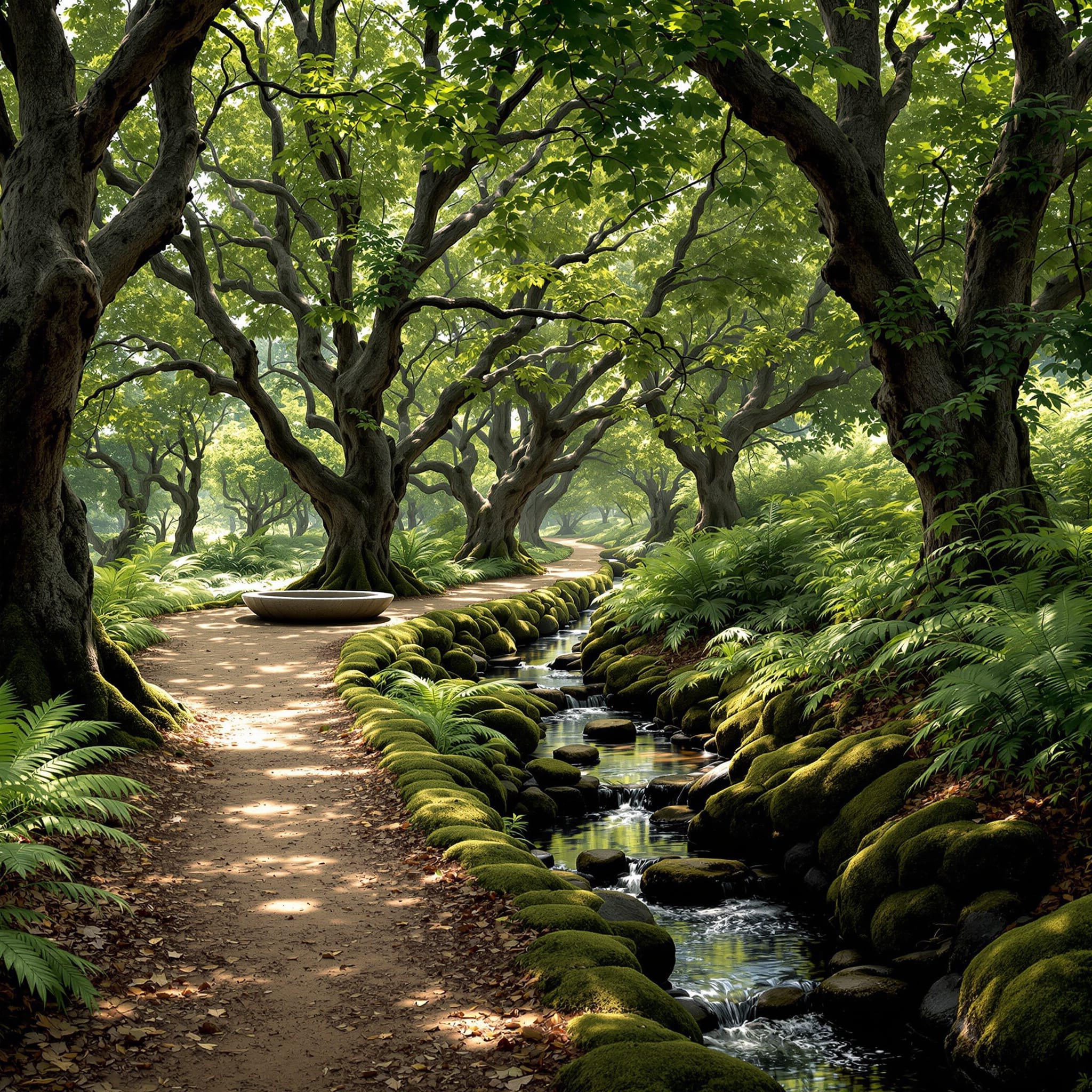
Behind it, the orchard began immediately. Not wild. Not abandoned. The trees stood in old rows, their trunks silvered with age, their branches held low and wide over a narrow path of packed earth. A channel of water ran beside it, no wider than her hand, slipping between stones dark with moss.
There was a sign just inside the gate.
ORCHARD MAINTENANCE ACCESS
The letters were chipped at the corners. Below them, someone had once painted an arrow. Time had worn it down until it pointed nowhere recognizable.
Neris stepped through.
The heat of the passage fell away behind her. Under the trees, the air held the dampness of the channel and the faint sweetness of fallen fruit. The path did not lead directly to the station. It curved first toward a low stone basin half-hidden by ferns, then disappeared between two trees whose roots had lifted the ground.
She could still hear the people moving on the other side of the wall.
She could hear, farther off, the warning bell at the platform.
The old path had not been destroyed. It had simply been placed behind a different route.
Neris stood beside the water until the bell stopped.
She could not afterward take the passage without hearing it.
Most people, when the cool air came, walked faster.
Almost no one put their hand on the latch.
— from the Spiral Vault