
The honey was the darkest on the row, and Elda knew it.
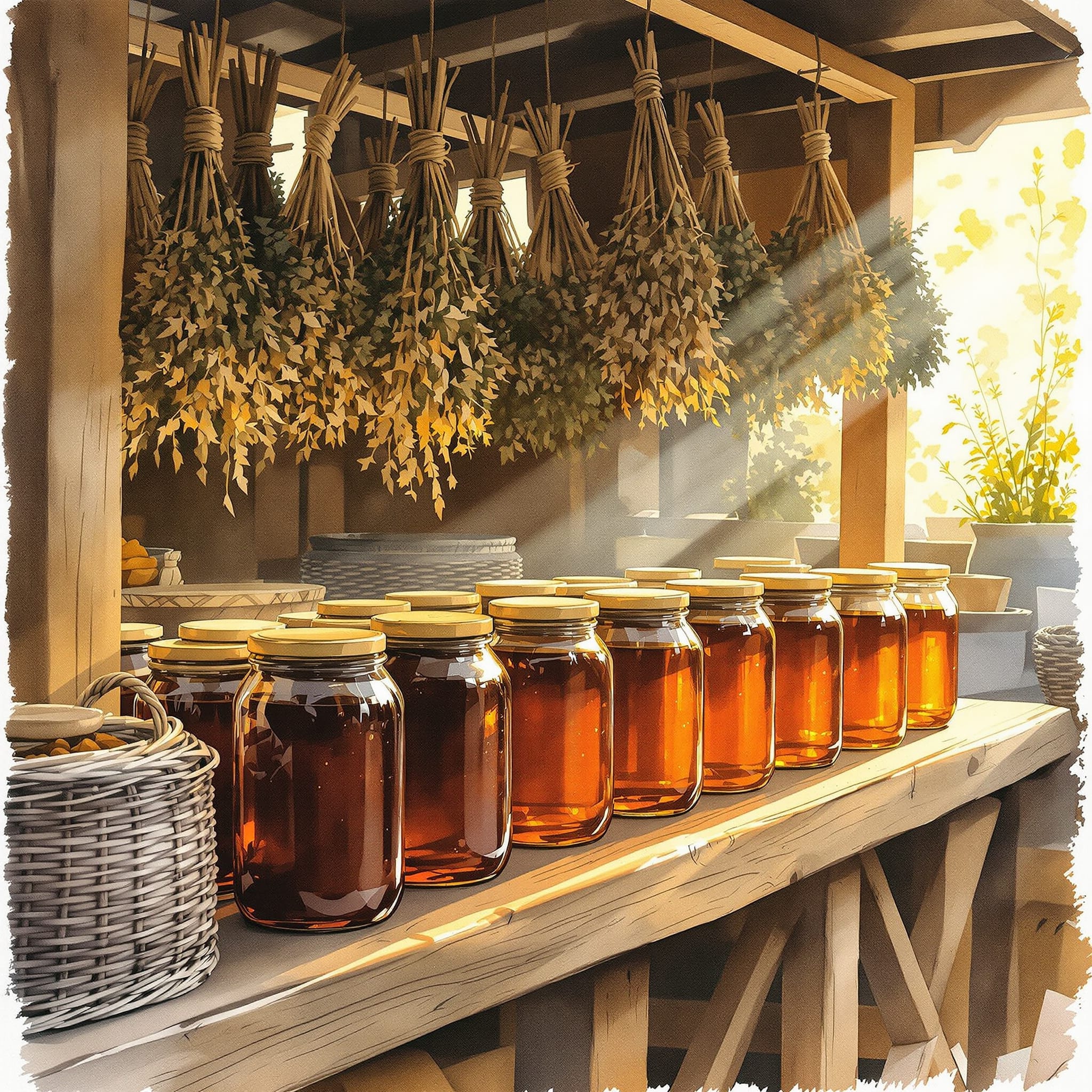
She had set the jars where the morning came through them, so the light had to pass the length of each one before it reached anybody’s eye. By then it had gone the color of a thing steeped rather than poured. Forest honey. Not the pale clover the lowland keepers sold three stalls down, thin and sweet as a child’s idea of sweetness, but the dark, resinous kind the bees made from whatever bloomed under old trees, bitter at the back of the throat and slow off the spoon. She turned the nearest jar a quarter so the seam of light moved along it. People bought with their eyes first. She had learned that before she learned anything else worth knowing.
The herb bundles hung from the frame behind her, tied at the stem and set head-down so the oils ran back into the leaf. She could have named every one of them with her eyes shut, by the smell alone. She did not say so. What she said to the woman turning a bundle of chamomile in her fingers was that it had been cut that week and dried in shade and not in sun, which was true and was what sold it. The woman bought two. Elda wrapped them in a twist of cloth and sent her off with the easy word she had for everyone. The stall breathed its green and amber breath around her, and the morning went the way mornings went.
She was good at the selling. She knew that much about herself. The rest of it, the part of her that could look at a leaf and know not only its name but its hour and its use, the part that had stood at her mother’s mother’s elbow and kept the whole of what she saw without ever meaning to, that part she did not think of as belonging to the trade. It sat beside the jars. It had never once occurred to her to price it.
The woman who stopped at midmorning did not look at the honey the way most buyers looked at it.
She looked at it the way you look at a door you are not certain will open. She was a big-boned woman gone thin at the wrists, dressed for work and not for market. She stood at the edge of the stall a moment too long before she spoke. Her hand closed and opened at her side as though it wanted something to hold. When she did speak it was not to ask a price.
“They say you know what things are for.”
Elda’s hands went on with what they were doing, straightening, settling, but slower now.
The woman told it plainly. She spoke the way frightened people tell a thing when they have already told it too many times inside their own heads. Her girl had come off a horse a fortnight past. The leg had opened at the shin and had not closed. It had gone the wrong colors, and the wrong smells. It wept where it should have knit. The flesh around it had drawn tight and hot, and the child could not stand on it now and did not sleep for the ache of it. She had washed it with what she had. She had bound it clean each day. She had done, she said, everything she knew. Her voice held on the word but thinned around it, and that was worse than breaking would have been.
“And it isn’t turning,” she said. “Whatever I do, it isn’t turning.”
Elda knew the answer. It came up in her before the woman had finished, whole and certain, the way her own name came up when someone called it across a crowd: the dark honey laid thick over the wound and the wound bound over it, changed morning and evening; the color of the leg watched and not the pain of it, because the pain would lie and the color would not. She knew it the way she knew the honey was the darkest on the row. She had known it standing still.
And she said nothing. At first.
Her mouth took the shape of it and let it go. She was a woman who sold honey. That was what she was at this stall, under this cloth, with her jars set carefully to the light: a good vendor and an honest one, who could tell you the flower and the week and the shade a thing had dried in, who took your coin and wished you well and did not follow you home into your griefs. The counsel was another matter. The counsel carried a weight the jar did not. To hand it across the boards as though she had the standing to hand it, as though a market woman’s knowing were the sort of thing a person could lean their child’s leg against, that was a line, and she stood on the near side of it and felt how far off the other side lay.
And beneath that, quieter still: she could not see the leg. She did not know how deep it had gone. If it had gone past the place honey and time could reach, then she would have said a thing that failed, and the woman would carry it home and lay it on her daughter and watch it fail, and either come back or not come back, and either way it would have been Elda’s word that did the failing.
The woman was still looking at her. The hand had stopped its opening and closing.
“Forest honey,” Elda said.
It was out of her before she had decided. Once it was out the rest came after, plain and unhurried, because she found she had no way to give the half of a true thing and leave the rest.
She told her how. Clean it first, gently, water only, nothing that stings and nothing that scrubs. Then the honey laid on thick, the dark kind and not the pale, thick enough that no air came at the wound, and a clean cloth bound over, and it all changed morning and evening, the old honey washed away soft before the new went on. She reached behind her without looking and brought down a bundle of the small, dried flowers that smelled of apples left too long in the bowl and set it on the boards. This for the child, she said. Steeped weak and warm, at evening, not for the leg but for the sleep. A leg mends faster on a child who sleeps than on one who lies awake all night fighting it. This would loosen the ache enough to let her down into rest.
She was clear. She was not sorry. She said what she had seen the honey do, the wounds she had watched it turn that had looked worse than a fall from a horse, and she did not soften it into a maybe.
And then she drew the line where the line truly was.
“I can’t see it,” she said. “I don’t know how far it’s gone. If it’s only angry, this turns it. I’ve seen it turn worse than what you’re telling me.” She held the woman’s eyes. “But if it’s gone deep, past the meat of the leg, then this isn’t enough, and you’ll want more than I carry, and you’ll want it quickly. So watch the color above the wound, not the wound itself. If the red climbs the leg, if it runs upward in a line, don’t wait on me or my honey. That is past what I know.”
She said it because it was true, and because the woman deserved the whole shape of the thing she was being handed, edges and all.
The woman took the flowers. She paid for the honey and would not be waved off from paying. She went.
Elda did not think she would come back. Most of them did not come back. You gave a thing across the boards, and it went out into a life you would never see again. The not-seeing was the ordinary shape of the trade.
She came back on the ninth day.
She came the way people come when they have spent the whole walk over refusing to let themselves believe it, careful in the face until she was near enough to be certain of being heard, and then not careful at all. The leg had turned. The colors had gone back the way colors were meant to go. The heat had left it. The wound had begun at last to close at its edges, the way flesh wants to when nothing is standing in its way, and the girl had slept. Three nights running she had slept all night, and that very morning had set her weight on the leg and stood.
She had brought something. A round of bread, still warm through the cloth, and eggs. She pressed them across the boards with both hands and would not hear that it was too much.
“There’s no one else,” she said. “I asked, after. There’s no one down the whole of this row who would have known that. And the ones who might have—” she stopped. “They would not have said it out to a stranger. Not the way you did. Not the whole, with the warning in.”
She said it and pressed the bread once more into Elda’s hands and left. Elda stood with the loaf warm against her palms and the market going on loud and ordinary all around her, none of it knowing what had passed between them.
She looked at the stall.
She had set it that morning the way she set it every morning with the jars turned to the light, the bundles hung head-down, and the good goods laid out to catch the eye. She had stood behind it certain she knew to the coin what she was worth across these boards. She looked at it now, and something in the arrangement had shifted while her back was turned, though nothing had moved. The jars were only jars. Beside them, where it had always sat, unpriced, the thing she had carried her whole life without weighing lay out in plain view. She saw at last that it had been the darkest thing on the row the entire time; she had set the honey to the light and left it standing in the shade.
Something turned over low in her chest, warm, and set her moving.
She looked up for the next.
Many hold a thing worth the holding.
Fewer set it down where a stranger’s hand can reach.
Fewer still give it across whole, keep nothing back for the shade, and turn, in the same breath, outward.
— from the Spiral Vault™