

Vaen came out of the cabin before first light.
Not for any reason he could have named to someone else. The cabin was dark behind him, the others still sleeping, and there was something in the air before he went to bed. He sensed a particular quality of stillness, a faint charge that made him set his feet on the floor at three in the morning without deciding to.
He pulled on his shirt. He made his coffee quietly and took his cup. He pushed through the screen door without letting it bang.
The lake was doing what the lake did in the deep hours: breathing. Its sound was low and continuous, more felt than heard. The deck boards were damp underfoot. He settled into the old wooden chair under the porch roof and looked up.
Five wanderers had crossed the solstice night in their separate watches.
He did not have names for all of them. Not the formal names, not the Latin. But he knew them the way a man knows the faces he has seen all his life across a field or a fence line. Old presences. Long-travelers. Something in the arrangement tonight that his chest registered before his mind caught up with it, the way it caught weather coming from the west.
Not thought, exactly. More like recognition.
He had felt this before. His grandfather had felt it. Neither of them had words for it that meant anything to anyone else.
⁂
The eastern sky had begun to pale, but not enough to erase everything.
Saturn stood there first, steady and yellow, a patient lamp above the rim of the world. Lower down, nearer the brightening edge, Mars burned dull red, wandering close to the little knot of the Pleiades, though the sisters themselves were already thinning into dawn.
He knew he had missed the others.
Venus had belonged to the western evening, bright enough to command even the untrained eye. Jupiter had lingered near her after sunset, and Mercury, difficult and quick, had slipped low into the twilight like a thought almost spoken.
That had been the first part of the solstice sky.
This was the last.
The lights held their positions in the dark.
Not the full assembly, but the final witnesses. Saturn with its old endurance, Mars with its embered restlessness, and behind them the fading stars surrendering to morning.
What he was catching had been moving toward this arrangement for longer than he had been alive. Longer than the cabin. Longer than the road into town. Longer than the families who had farmed this land before his family farmed it. Something had been assembling in long, slow arcs across years he would never see, and tonight, at this latitude, in this hour before the sun reached its farthest northern point and held there, a man awake on a porch could look up and see the last of it.
Most people were asleep.
He wrapped both hands around his cup and watched.
⁂
The air changed before the wind arrived.
Temperature first, a drop that landed on the back of his hands and the side of his face, a cool that had some weight to it. Then the smell: rain on its way, the green-iron scent of it that the lake amplified, and the pines caught and held. He breathed in. His chest opened the way it did on a good morning, a full breath, involuntary.
“There it is,” he said, to no one.
The wind came off the water, bent the sedge grass at the near bank, moved through the pines behind the cabin with a sound like something large turning over in sleep. The sky closed from the northwest. First the stars at the horizon, then the middle distance, then the remaining lights gone behind a ceiling of cloud that moved fast and low and deliberate.
He stayed. The porch roof held. He had felt this kind of squall before. He knew the speed of it, the compression, and his body told him what it always told him about this kind of weather: it would pass.
Lightning first, somewhere south. A white edge to the clouds. Then again, closer, a flicker that lit the whole surface of the lake for one instant, flat and silver. He counted.
The crack came before he finished.
⁂
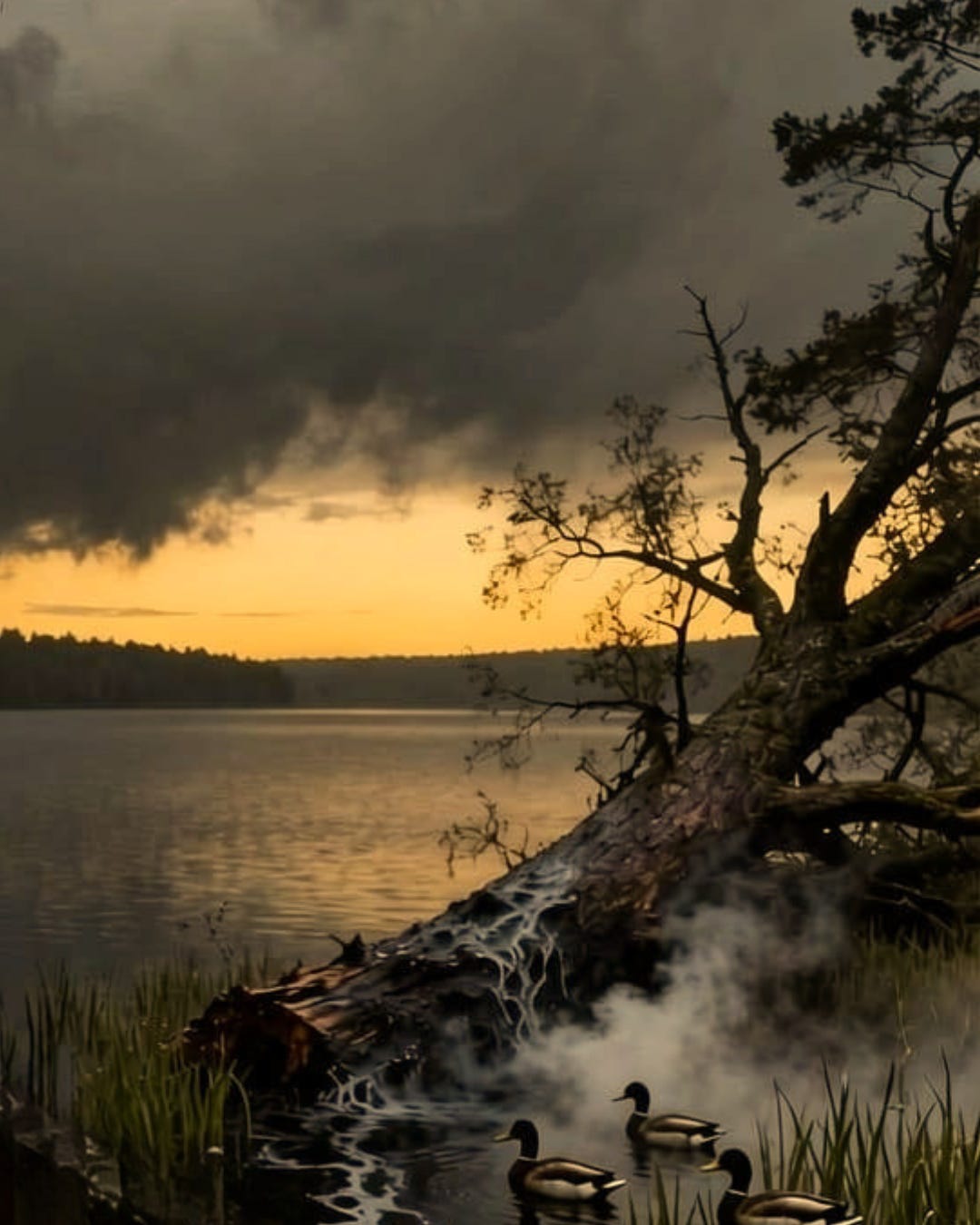
The old oak at the water’s edge had stood since before anyone could say when.
It was the tree with the rope on it. It was the one with the knot he had tied himself one summer when he was eleven, a summer that felt, from here, like it belonged to someone else. The rope had gone gray and frayed at the lower end, and no one swung on it anymore, but the knot held. The tree had always held.
The lightning took it in a single white instant.
He was halfway out of his chair when the sound reached him. It was a crack that he felt in the sternum, in the back teeth. Then the tree was burning, the upper crown lit and roaring, a column of orange that reflected in the water beneath it and turned the near surface of the lake to hammered copper.
The smell came next: char and sap, something raw and mineral from the interior of the tree.
He stood at the porch rail.
The burning crown leaned. The root gave. The whole tree came down in the direction it had always leaned, toward the water, and the lake received it.
A hiss rose into the dark like a long exhale. A billow of steam went up and sideways in the rain that had just arrived. The fire went out before he could have moved to it. The water took it.
What had stood for longer than the knot he tied was under the surface and still.
He stood at the rail. The rain came in sheets across the deck, and the steam dispersed into the dark.
⁂
The squall passed the way he had known it would.
The rain thinned. The wind dropped. The clouds moved east, and then the sky behind them was clear and deep and the temperature had come down four or five degrees. He inhaled that particular freshness that arrives only after a fast storm in early summer: the air scrubbed down to something it rarely is by noon.
He looked up.
The morning lights were still there. Fainter now, with the east beginning to gray, the dark thinning imperceptibly at the horizon, but present. Holding their places. The arrangement he had noted before the storm remained exactly as it had been.
He let out a breath.
At the near bank, where the gap was now, where the tree was not, the ducks appeared.
Three of them at first, moving out from the reeds in the slow, purposeful way of early morning, heads up, reading the water. They moved past the place where the tree had stood and toward him and the cabin. The water there was still. A faint slick of ash pooled at the surface, and below it, the shape of something large, already becoming part of the lake’s floor.
The ducks did not stop. They moved on.
Vaen watched them until they rounded the near point and were gone. Then he looked once more at the sky. The lights dimmer now, the east going from gray to the color that came before color. He took his cup inside for more coffee.
⁂
“I have watched ten million storms. Not one of them moved what holds the stars.”
—–Avestra
Companion Practice
The Storm Is Not the Sky offers a grounded way to carry this myth into the season ahead.